Showing posts with label Skills. Show all posts

Friday, July 18, 2025

Set the Heads'l! It's the Sailors Career

This time out we are looking at the Sailor career from COTI. 


Sailors: Members of the Nautical Force Command (the wet navy) of a world.

Naval Force Command is informally called the Wet Navy, to distinguish them from their space-faring counterparts. The descriptive text gives us nothing else about the service.

Any world with a Hydrographic rating above 1 could have a Wet Navy, and above Hydro-5 is likely to do so. Worlds technology levels at or below contra-gravity would still make use of sailing vessels. The conventional wisdom is that a new settlement will go next to a body of water. Transport of people and especially goods by water is an order-of-magnitude less expensive than by road, rail or air. even in the Far Future, sailing the ocean blue will be a thing. And we all know that sailing the seas can lead to Adventure.

Career Figures

Enlistment throw is 6+ with DMs for END and STR. Not a difficult career to get into. Survival is 5+ like the Flyers, with an END DM. Not too dangerous, but more risky than Doctors.

Getting a Position/Commission is also 5+ with a DM for INT 9+. Promotion is at 6+ with a DM for EDU 8+. These numbers are not high.

First observation: of 40 pregen characters, there is only one Admiral (rank 6) and three Captains (rank 5). Odd. 22 of the list are unrated ordinary seamen, including several with four or five terms.

Sunday, January 26, 2025

Take to the Skies! the Flyer Career

Clear the Flight Decks! 

Flyers: Members of the Close Orbit and Airspace Control Command (the air force) of a world. The description text includes this suggestion:

Each character is assumed to have undergone the mustering-out procedure, although the Referee may elect to use them as if they are still employed in some form of flight activity.”

I know these days we're all about Unmanned and Remotely Piloted vehicles. In the Far Future, however, it is contrary to the spirit of Adventure to let the drones do all the work. Strap into your cockpit and let's examine this career choice.


The Army and Marines are two of the Original Six careers, so the inclusion of the Air Force in COTI is not a surprise.

Unless you have a copy of Striker, Classic Traveller gives you very little direction on how to employ aircraft, especially combat aircraft, in adventures.

The MegaTraveller supplement COACC has design tables for aircraft at several tech levels, and these can be easily back-converted into Classic.

In the OTU and in my Church and Empire setting, there are many worlds with the right atmosphere & tech level combinations for aircraft to be a common mode of transportation. Having Travellers familiar with aircraft operation can be very handy.

Tuesday, January 23, 2024

More on Careers - Barbarians!

 What does it mean to be a ‘barbarian’ in the Far Future?

Merriam-Webster defines barbarian as “a person from an alien land, culture, or group believed to be inferior, uncivilized, or violent”. Let me emphasize some of those words.  Inferior. Uncivilized. Violent

OED has several definitions. The most relevant two are:

A foreigner, one whose language and customs differ from the speaker's

A person living outside the pale of the [Roman] Empire and its civilization

With the general idea being simply ‘you’re not one of us, and that fact makes you inferior’.

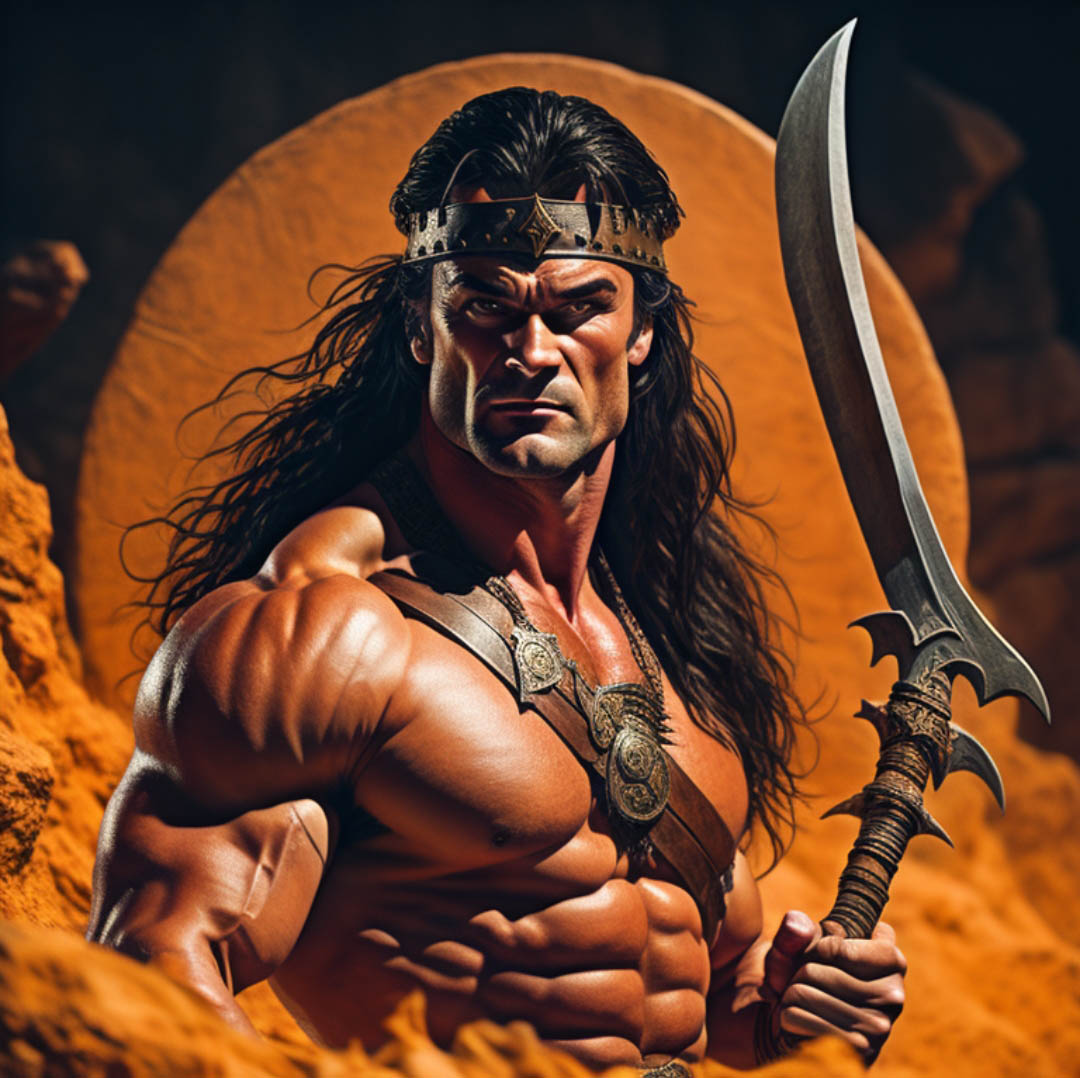
For many fans of adventure fiction, ‘barbarian’ brings to mind Conan the Cimmerian. He wears hides & fur, and wields a sword. If you read Howard’s works, you find that the differences between Conan and the ‘civilized’ people have little to do with technology. Conan despised ‘civilization’ because he saw it as morally bankrupt. He was not jealous of their fancy toys.

This is an AI generated image
This is an AI-generated image.

We readers can also see Conan as ‘primitive’. Compared to 20th/21st century technology, Cimmeria was primitive. Compared to Aqilonia, they were not that far behind. Lack of sophisticated technology does not make one a barbarian.

Here’s another definition. Civilized is defined as “At an advanced stage of social and cultural development, usually marked by the existence of organized communities and an adherence to established conventions of behaviour; highly developed; refined and sophisticated in manner or taste; educated, cultured”

OR

a relatively high level of cultural and technological development”

A modern New Yorker, with his smart phone and digital everything (TL 8-9) might think of the poor rural dweller in, well, anywhere that isn’t NYC, to be a primitive. He doesn’t have a smart phone and a Tesla model 4! He does have other accoutrements of TL 7-8 life, though. Cable television, modern medicine, new model cars, and a comparable public education.  All that it takes is one TL of difference. The label barbarian may be all in the eye of the beholder. Small-town man does not think of himself as a barbarian, or inferior to fancy-pants city man.

In my Church and Empire setting, from the Talaveran point of view, all the residents of the Corridor could be considered barbarians. Their tech is lower (how uncivilized!), sometimes far lower. They don’t speak Talaveran. They do not hold to Talaveran customs of behavior. Thus, barbarians. Barbarian can be no more than a term of snobbery, a means for looking down upon one’s fellow man. Pride of race/culture. I don’t present the Corridor worlds that way, and my play group has not adopted this attitude, I’m pleased to say.

Keep in mind, that Stavanger is TL-12 and Lanzhou is TL-13. Almost as good as the Empire, but still behind. But do they therefore not meet the definition of ‘civilized’? Of course they do! Mavramorn and VanGoff’s World at TL-10 out-do modern America. Yes, they’re civilized.

What I’m getting at is: think beyond the stereotype of the pidgin-speaking, melee-weapon, primitive barbarian. A barbarian can come from any world, at any tech level. They are a group apart, separated for whatever reason from the main government and society. They might come from a Subordinate world, or live out on the edge in Ungoverned Space.

Let us now consider the Barbarian career, both what it states, and what it implies.

Monday, June 19, 2023

Duelling in Space

In our last session, a player brought a character to the table, which was a product of this online generator: https://www.batintheattic.com/traveller/

Barbarian Warrior Logan Singh B5A758 Age 46 7 terms Cr4,000 
Skills: Brawling-1, Carousing-1, Mechanical-1, Recon-1, Short Bow-2, Sword-7


Yeah, I put that last one in boldface on purpose. I have remarked before on this blog about how high levels of skill are possible. See Enrique Salazar for one. Now there's one in play in my TU.

Monday, March 20, 2023

More on Skills: Administration

Let's look at Admin skill . . .

Administration: The individual has had experience with bureaucratic agencies, and understands the requirements of dealing with them and managing them. When contact with officials is required, understanding their needs and motives will assist in dealing with them. A basic throw of 7+ will successfully resolve normal interaction without further problems (such as avoidance of police harassment, insuring prompt issuance of licenses, approval of applications, avoidance of close inspection of papers, etc.). Apply these DMs: no expertise, -3; per level of admin expertise, + 2.

When serving in a bureaucratic organization, admin expertise allows competency in the eyes of superiors. Apply a DM of +1 per level of expertise, with the exact throw to be determined by the referee under the circumstances.

Referee: Admin expertise should also affect the quality of work and potential for success of an organization which the character is controlling or managing. (emphasis added)


One of these people has Admin-5. Can you guess which one?

Monday, January 23, 2023

More on Skills: Carousing and Streetwise

In this series of posts on skills, I have assumed that the given skill descriptions were suggestive, not restrictive. ‘Generally, the skill works for this, but other uses may occur to players’.

 In Traveller, a PC’s skills are the primary tools for interacting with the universe. They are the first measure of a character’s power. The skill list in CT is not large, so it is only sensible for skills to have broad, not narrow, application. You don’t need a big list of skills to be a worthwhile character.

Sometimes, though, skills seem to overlap. This is one of those cases.

Streetwise and Carousing: Close but not Quite the Same

Streetwise: The individual is acquainted with the ways of local subcultures (which tend to be the same everywhere in human society), and thus is capable of dealing with strangers without alienating them. This skill is not the same as alien contact experience. Close-knit subcultures (such as some portions of the lower classes, trade groups such as workers, and the underworld) generally reject contact with strangers or unknown elements. Streetwise expertise allows contact for the purposes of obtaining information, hiring persons, purchasing or selling contraband or stolen goods, and other shady or borderline activities.

Referee: After establishing throws for various activities desired by the characters, allow streetwise as a DM. If streetwise is not used, impose a DM of -5.

I realize this picture has nothing to do with the topic. Rule of Cool, people.

I have often looked at this skill as “how to crime”. Note the underlined phrase above. Now I think of it as also being “I know a guy” and “figure out who's who”. Streetwise is the more familiar skill, coming from Book 1. Carousing was introduced in Book 5. For the most part, I’m talking today about Carousing.

Monday, November 7, 2022

More on Skills: Naval Architect

Presenting possibly the least useful skill introduced in the Advanced Character Creation books!

Definition, from Book 6 Scouts

The individual has been trained in the design of starships and small craft. Knowledge of the requirements for accurate, usable ship design plans and of the details of ship design are part of this skill. The character is capable of acting as a naval architect, subject to the level of skill attained.

Naval Architect-1 is sufficient to occasionally design ships, especially for personal or group use, but generally requiring three or four times the time called for by a professional (about 16 weeks). Naval Architect-2 allows design of a ship in 10-12 weeks. Naval Architect-3 indicates a level of skill approaching professional. Naval Architect-4+ allows the individual to function as a professional naval architect.

This skill operates in conjunction with the established starship design and construction rules, and does not allow the invention of new devices or equipment.

First of all, Naval Architect skill (hereafter NA) is found in the Technical School skill table, roll 5. This is the only instance of the skill in the skill tables. So it is rare for a Scout character to get it at all, let alone to have it at skill level above 1.

Once acquired, it does exactly one thing: draw plans for ships. No throws are suggested, the skilled PC has only to take the time and produces the results. There is, as far as I can imagine, exactly one instance where this skill would come into play. That is, a group of PCs want to build their own ship, or pay to have it built. NA skill will save them some money up front, but that’s all.

I would like to learn the rationale for including a skill with this narrow of an application. In contrast, Book 1 skills are widely applicable. Compare NA with Mechanical for an example. With this skill, a PC can attempt to build or repair or destroy any number of manufactured devices. Mechanical works on starship airlocks or factory machinery or ATVs. NA can produce blueprints, a narrow application.

To the end of making NA more useful, let’s see if we can broaden out NA skill.

Friday, October 28, 2022

The Big CT Skill list and Book 1 Characters

One of the popular features of the “Advanced Character Generation” systems in books 4-7 was the introduction of new skills. Along with this came the controversy over ‘skill bloat’, which I have addressed elsewhere. I have nothing more to add here; I’m interested in the skills as skills.


Not all of these advanced skills are equally useful, but many of them are clearly beneficial. I got to thinking about how to work them back into Book 1 character creation. I have two ideas to present. Both result in the players having access to a wider array of potential skills, without the skill bloat.

The first is to derive the 'advanced book' skills with the skill set from Book 1, then allow players to choose: if you roll Skill X, you can take it, or substitute one of the derived skills attached to it.If you're not familiar with what a skill does, the Traveller Wiki is a good resource to explain. (Find the link under "Check out Other Traveller Sites" in the sidebar)

The second is compiling an 'alternate' Service Skills table – or a Table 5, whichever you prefer – for each of the original six services.

It would not be wise, I think, to throw open the gates and let a character in any service take any skill from the full list. That would invalidate the concept of services being distinct organizations doing specific things.

Friday, October 22, 2021

From Front Office to the Frontier - the Bureaucrats Career

 Adventures in the Office? Or maybe more than meets the eye?


What are Bureaucrats?

Individuals serving a government or organization in a management or executive capacity.” From The Spinward Marches Campaign version of the COTI careers. In the Supplement book we find the same. The only useful addition is from the pages of sample Bureaucrats: “They are assumed to have mustered out of their particular bureaucratic service and have embarked on some sort of activity within the universe.” [As opposed to outside of it?]

I have long regarded the Bureaucrat career as a placeholder. Something to round out the COTI tables to a multiple of six entries. Paper-pushers at the Department of Redundancy Department. Why would anyone from this background become a Traveller?

The usual answer is “they got bored with the desk job.” I suppose that serves well enough for now. I cannot think of any examples from adventure literature of a cubicle-dweller deciding to live a life of Adventure, except perhaps as a comic relief or buffoon character that the actual heroes have to protect. If you know of a good example, please share in the comments!

Let's take a look at the nuts and bolts of the Bureaucrat career.

Enlistment: 5+ (83%) plus DMs for EDU8+ and STR 8-. This is the only career that grants a DM for a physical stat below a target level. Pretty low bar for entry. Education is the key characteristic for this career. It pays to know stuff.

Friday, September 17, 2021

Follow me, men! More on Skills - Leadership

The skill as described in Classic Traveller:

The individual has led troops in battle or on adventures and is possessed of a knowledge and self assurance which will make for a capable emergent or appointed leader.”

Like this guy here: 

Leadership is a specifically military skill, then. I had long assumed that Leadership was good for any instance of a PC directing NPCs. There's nothing wrong with playing it that way, but that's not what the skill description indicates.

Leadership is a required ability to control a group of more than six no player hirelings or soldiers. Such a group will tend to obey the general orders of the character with the highest leader expertise. Reaction throws are necessary when the leader and the group first meet. DMs may be applied: +1 per level of leader expertise when consulting the reaction table.

Leader-3 or better is sufficient to allow soldiers to obey orders without hesitation. Leader-4 or better will allow a positive DM when recruiting soldiers or hirelings for adventures. The throws and DMs for such hirelings depend on the situation imposed by the referee.”  This is the only direct reference to hirelings I could find in CT.

Thursday, February 18, 2021

Forget Adventuring, Become a Broker!

 In the article High Finance by Terry McInnes from JTAS #13 

"After a character has reached his late 50's or early 60s - an age when rough and tumble adventuring loses its appeal, he may wish to . . . settle into the brokerage business. Cargo brokers help ship captains get increased prices for their goods and charge a percentage of the final price for their services. Brokers also arrange the sale of goods by planetside farmers and manufacturers to ship captains who invest in these cargoes for resale to another world."

Cargo Brokering. Wow. You can make an absurd amount of money with this little technique, all without the wear and tear of adventuring. I ran the numbers, keep reading and you'll see.

So you're sure this cargo isn't illegal on this world, right? Ohhh-kay.
The general process is this: the Referee determines the number of captains per week who may want to contract with the broker. This is presented in the article as always being a non-zero number. Perhaps this should be modified by the starport rating of the world the PC works from.

Friday, February 12, 2021

More on Skills - Steward Skill

Ah, the Steward. The Dump Stat of Traveller skills. Even less popular than Jack of All Trades. Why is this skill here? Here's the skill description from TTB:

The individual is experienced and capable in the care and feeding of passengers: the duties of the ship's steward.

The responsibility for the welfare of passengers aboard a starship falls on the ship's steward. Although anyone can be hired as a ships' steward, this skill represents training in the various duties necessary, and serves as an advantage when attempting to get such a job.

Referee: Steward skill represents a general awareness of cooking, personal care and attention, and other areas of experience which will make passengers and crew happy and content with their conditions of passage.


As given, this does not tell the player much about what the Steward lets you do, or how it can lead to adventures. But it can, and like every other skill, it should.

What does the Steward skill do? The Steward skill turns NPCs into revenue, or into adventures.  


Tuesday, September 8, 2020

Fire for Effect! the Forward Observer Skill

The Forward Observer skill has long puzzled me. When I was a teenager getting into Traveller (in the 1980's) I could not get my head around what the Forward Observer skill was good for. Why did they include it? Now these many years later, I have an answer for that. It turns out that I've missed out on some exciting adventure opportunities!


The first reason that FO skill confused me is that to me this skill deals with Big Guns - mortars & howitzers; you know, artillery. Classic Traveller has next-to-nothing to say about Big Guns, at least ground-based ones. The Book 1 Gunnery skill is primarily about starship weapons. The skill text does say that “Gunnery may also be used for similar weapons mounted on ATVs or air/rafts.”

which suggests that these vehicles can have energy or projectile weapons. The Vehicles section mentions AFVs but nothing whatsoever about how to adjudicate fire from Big Guns. Starter Traveller didn't even mention AFVs.


A quick digression. Back in the day I did not conceive of the rules as a toolkit for adding my own features into a Traveller setting. I expected the publishers to do it all for me. I have since changed my outlook.

Where was I? Oh yes. Without rules to define and use Big Guns, I had no way to actually use the FO skill except in the most abstract sense. I also lacked the real world information and the sci-fi reading background to make use of the FO skill by whipping up some Big Gun rules.

I think the FO skill did not survive past the Classic edition of Traveller. If later editions still have it, please enlighten me in the comments. If you open up Book 1, it is available on the Service skills table for the Navy, and the Army. If you look in Book 4, Mercenary, FO skill appears on the Artillery and Marine MOS tables, the Staff and Shipboard skill tables. Note in Book 1 this is a skill for Navy and Army types; in Book 4, it becomes a Marine skill as well. It appears in Book 5, High Guard on the Shore Duty and Gunnery MOS tables. Book 4 also introduces the Field Artillery gunnery skill. I'll add a thought on that later.

Friday, July 31, 2020

Hunting Big Game in Traveller

Question: How many shots does it take to bring down an elephant?
Answer: Either One, or lots.

In CT the animal creation process is flexible and simple enough to allow a Referee to create new creatures on the fly. The table scales from 1 kg (rats, rabbits) to 44,000 kg (dinosaurs, dragons, whales).
  • A 6,000 kg creature (e.g. a forest elephant) has 9D/4D hit dice. Average 32/14, max 54/24
  • A 12,000 kg creature (e.g. an African bush elephant) has 10D/5D hit dice. Average 35/18, max 60/30
This is an elephant to scale with humans, for comparison.

Problem is, it is astonishingly unlikely that a Referee will roll up 'max hit points' with random rolling, at these levels.

Tuesday, July 14, 2020

Athletics Skill in Cepheus Light

Here's a fun optional rule that can liven up your CL game.

At Athletics-3, characters gain the ability to use Parkour for movement around urban areas or aboard ships.

[From Wikipedia] Parkour (French) is a training discipline using movement that developed from military obstacle course training. Practitioners . . . aim to get from one point to another in a complex environment, without assistive equipment and in the fastest and most efficient way possible. Parkour includes running, climbing, swinging, vaulting, jumping, plyometrics, rolling, quadrupedal movement (crawling) and other movements as deemed most suitable for the situation (not to be confused with freerunning). Parkour's development from military training gives it some aspects of a non-combative martial art.

Parkour is an activity that can be practiced alone or with others and is usually carried out in urban spaces, though it can be done anywhere. Parkour involves seeing one's environment in a new way, and imagining the potential for navigating it by movement around, across, through, over and under its features.

A practitioner of Parkour is called a traceur (M) or a traceuse (F).

Some examples of common movements are:
  • Vaulting over obstacles.
  • "Precision" Jumping and landing accurately with the feet on small or narrow obstacles.
  • "Arm Jumps" Jumping and landing feet-first on a vertical surface, catching the horizontal top with the hands.
  • Using a rolling motion to help absorb impacts from larger drops.
  • Running towards a high wall and then jumping and pushing off the wall with a foot to reach the top of the wall.
  • Moving from a position hanging from a wall-top or ledge, to standing on the top or over to the other side.

Friday, June 5, 2020

Unskilled Weapon Users

Can you find the Unskilled fighter in this group?

I read recently a post on anther blog about the differences in fighting capability in classic D&D. A 'normal man' has less damage resistance. His to-hit numbers are higher than the PC's, and his saving throw numbers are higher as well. The post made the case for the clear superiority of the dungeon-delving adventurer. Can the same be said for Travellers?


Well, yes!

I refer to TTB, page 37.

Any character using a weapon in which he or she has no training is subject to a penalty of -5 when attacking and +3 when defending. All player characters automatically have an expertise of zero . . . in all weapons shown in this book. [I call this the Weapon Mastery advantage] This zero value is sufficient to avoid the no-expertise penalty, but it is not enough to provide a positive DM. Payer characters selecting their weapons should consider the potential benefits of their strength and dexterity levels and any DMs that might be available for those characteristics.”

The PC's Weapon Mastery advantage means a PC will never get caught at a loss owing to unfamiliar weapons. Any PC can take on ANY opponent on reasonably equal ground. A knife fight in an alley to a formal duel in the Duke's courtyard with laser pistols to open field battle. How many of us could say that?

Speaking of Weapon Master, here's one example of what it looks like. Note the way Shiu Lien's attacks change as she goes through a variety of weapons.

She uses:

  • a sword, including dual-wielding
  • a spear
  • sword-breaker hooked swords
  • a huge pole-arm (and an example of not meeting the Required Strength)
  • a massive bronze cudgel
  • a broadsword
all without breaking stride. That's Weapon Mastery.

It makes your two-term Other character seem a little more awesome, doesn't it? Fighting in a training hall, your PC could do the same.

Thursday, October 10, 2019

Traveller Experience Rules

I've written about Traveller's Experience system before. 

I do not understand why this system has not been used more widely, even among Traveller players. It is simple to understand and requires FAR LESS BOOKKEEPING than the other major experience system in play in the old days. 

That other RPG's experience point system led to a type of metagaming known as the "XP quest" where PCs would kill & steal and do whatever for no in-game reason, but only to get enough XP to "level up". While not everyone did this, it was common. I played this way at times as well. You had to track every little thing you picked up, and every monster encounter was evaluated in terms of the potential XP gain.

It took multiple adventures to gain enough XP to level up, and only after three or four levels would a PC see any growth in their To Hit numbers or saving throws - which is what most players really wanted.
Contemplating a third term in the Scouts. Should he risk it? Again?

Traveller's Experience rules were simple by comparison. 

Monday, July 22, 2019

A High-Level Traveller Character

I have written before about High Level Play in Traveller, and what that might mean. Today I want to share a character I've created, to illustrate what that might look like. 

Here is the character, right after character generation finished:

Jackson Law     Age 22   7A87B5     Ex-Army Captain
Tactics-4, Rifle-1, SMG-1, CG Vehicle-0, Carousing-0
Cr 2,000        
Our good Captain. Still a young pup. That will change.


Quite the junior tactician, eh?  But out of the service after only one term. What's that about?  Was it because of his low SOC that the other officers didn't approve of the young man?  Well, could be a lot of things.

Skip ahead 20 years.

Friday, May 31, 2019

The Most Dangerous Skill - Bribery

From Faoladh, in the comments section on an earlier post:
"I suspect that the reason most players don't use Bribery is simply because most aren't used to thinking of it as a way of doing business, but instead think of it as a form of corruption first. Perhaps it is, but that isn't the way that everyone in the world thinks of it. Referees, too, have to leave room for bribery to be just part of the cost of doing business instead of setting off alarm bells every time that a player leaves a stack of Cr100 notes in the middle of their passport."

Nothing to see here. Move along, citizen.

How It Works


Bribery is a Basic Skill from Book 1, and can be acquired by Merchants and Others. In Supp-4, Rogues can also get this skill. It makes sense to me that at least Diplomats, Bureaucrats and Pirates or even Sailors should be able to have this skill as well, but it is not there. The block quote here is from Starter Travller's Rule Book.


Let's break this down.

Tuesday, March 5, 2019

More on Careers - One Rogue Too Many

I have not played any of the versions of that other RPG from the 1970's, where they re-named the Thief class to the Rogue class. Why, I wonder, did GDW feel it was necessary to use the vague and dissembling nomenclature 'Rogue' when 'Criminal' would have been more accurate? Or would it have been?

Something shady is going on here.

The text description of the Rogues reads as follows: "Criminal elements familiar with the rougher or more illegal methods of accomplishing tasks." I guess it would be more accurate, then. But wait. The word rogue is defined as: 1) a vagrant or tramp, 2: a dishonest or worthless person, a scoundrel. There are a few more connotations, but none are specifically criminal in nature. So, many Traveller PCs could be characterized as Rogues, regardless of what career they went through.

Let us speak truth, a great many Traveller PCs from back in the day were essentially criminals regardless of their chosen background career. They were smugglers, bandits, thieves, hired guns, burglars, and so on. Why the need for a separate career to breed them? Most player, myself included assumed that if you wanted a criminal PC, you went with the Other service. So this ground has been covered already.

Most of the skills the Rogues career offers (discussed later) are not specifically criminal, and with the random skill allocation process, there's no guarantee a PC will come away with a criminal CV. The free Service Skill is Streetwise, not a necessarily criminal skill. This would have been the time to introduce some new skills for the criminal class, but Supp4 does not do this. 

Later editions of Traveller introduced more criminal skills like Intrusion or Lockpicking. I suggested elsewhere that espionage activities (criminals on a payroll) could be handled with Basic skills and attributes. That way any PC could try their hand at clandestine activity

I actually have the chronology backwards. Supplement 4: Citizens of the Imperium, in which the Rogue career made its appearance, was first published in 1979. This is several years before that other game made the change. So why did they go along with GDW?

Let's have a look at the Rogue career, shall we?