Showing posts with label Role-playing Technique. Show all posts

Friday, February 13, 2026

More About High Level Play - Paths to Get There

From the Traveller Book, Introduction chapter, “Adventuring in Traveller”

Traveller is a set of detailed rules covering how the universe operates. These rules govern day-to-day activities to be expected for any individual. Against this background of basic information, players can work, earn money, travel to distant worlds, and lead exciting lives of daring and adventure.

But Traveller does much more. The characters have an opportunity to undertake genuine adventures as they search for their own self-appointed goals. Some adventures happen as a result of day-to-day activity. Some occur as players use pre-written adventures . . . (m)ost Traveller adventures come from the referee's own imagination. Each new world is an opportunity for the referee to present a new situation to the players, who must cope with this scenario if they are to progress in their own adventures. (emphasis mine)

What's the win condition? What you (the player) decide it's going to be.

When you start playing Traveller, you look for patrons, NPCs who tell you what to do. Your PC uses skills and equipment to accomplish the mission. As a player you learn how Traveller 'does' as a game. Marc Miller states in the Experience chapter that real experience in Traveller is in the realm of the player. “Experience gained as the character travels and adventures is, in a very real sense, an increased ability to play the role which he or she has assumed.” That role is a person in a setting who interacts with other people in that setting. That person will develop goals of their own in the setting, beyond what the patron of the adventure wants. (See above)

The End State or Goal in Traveller is the same for everyone.

Thursday, March 14, 2024

Signal Boost

 This is outside of my usual kinds of posts, but I feel like it's worth doing. While Traveller is my main game, it, like all other RPGs owes a debt to The World's Most Popular Role-Playing Game. Also, it is Good and Right to know your history.

Ad Fontes!

https://jonmollison.com/2024/03/13/told-you-so/

From Mr. Mollinson:

At the 21ish-minute mark, Jason launches into a very interesting story about pre-GenCon tournament D&D play.  What it looked like.  What players did.

SPOILER ALERT:  The #BROSR was right.  About everything.

Link to the issue of Europa: https://whiningkentpigs.com/DW/oldzines/europa6-8.pdf


Tuesday, January 23, 2024

More on Careers - Barbarians!

 What does it mean to be a ‘barbarian’ in the Far Future?

Merriam-Webster defines barbarian as “a person from an alien land, culture, or group believed to be inferior, uncivilized, or violent”. Let me emphasize some of those words.  Inferior. Uncivilized. Violent

OED has several definitions. The most relevant two are:

A foreigner, one whose language and customs differ from the speaker's

A person living outside the pale of the [Roman] Empire and its civilization

With the general idea being simply ‘you’re not one of us, and that fact makes you inferior’.

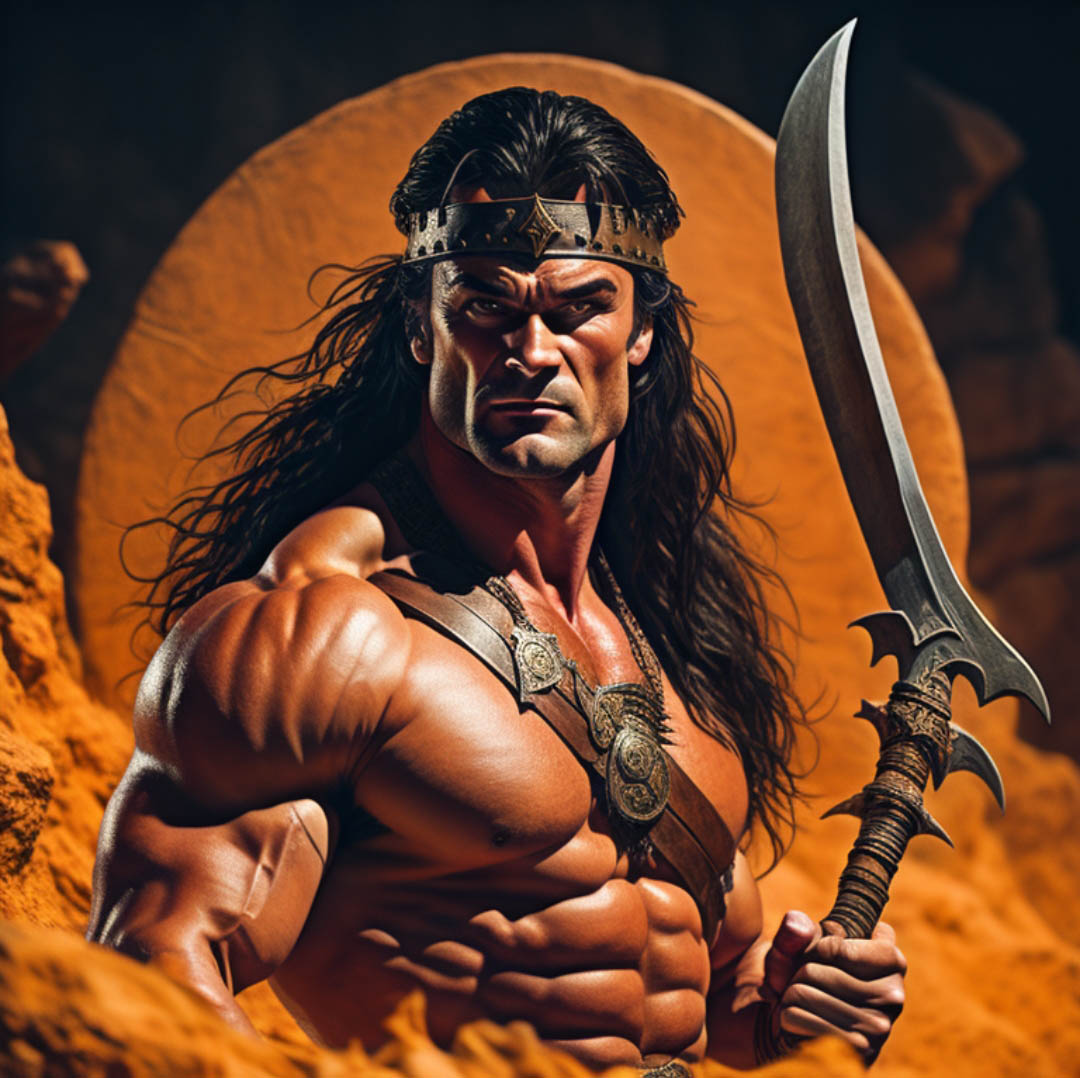
For many fans of adventure fiction, ‘barbarian’ brings to mind Conan the Cimmerian. He wears hides & fur, and wields a sword. If you read Howard’s works, you find that the differences between Conan and the ‘civilized’ people have little to do with technology. Conan despised ‘civilization’ because he saw it as morally bankrupt. He was not jealous of their fancy toys.

This is an AI generated image
This is an AI-generated image.

We readers can also see Conan as ‘primitive’. Compared to 20th/21st century technology, Cimmeria was primitive. Compared to Aqilonia, they were not that far behind. Lack of sophisticated technology does not make one a barbarian.

Here’s another definition. Civilized is defined as “At an advanced stage of social and cultural development, usually marked by the existence of organized communities and an adherence to established conventions of behaviour; highly developed; refined and sophisticated in manner or taste; educated, cultured”

OR

a relatively high level of cultural and technological development”

A modern New Yorker, with his smart phone and digital everything (TL 8-9) might think of the poor rural dweller in, well, anywhere that isn’t NYC, to be a primitive. He doesn’t have a smart phone and a Tesla model 4! He does have other accoutrements of TL 7-8 life, though. Cable television, modern medicine, new model cars, and a comparable public education.  All that it takes is one TL of difference. The label barbarian may be all in the eye of the beholder. Small-town man does not think of himself as a barbarian, or inferior to fancy-pants city man.

In my Church and Empire setting, from the Talaveran point of view, all the residents of the Corridor could be considered barbarians. Their tech is lower (how uncivilized!), sometimes far lower. They don’t speak Talaveran. They do not hold to Talaveran customs of behavior. Thus, barbarians. Barbarian can be no more than a term of snobbery, a means for looking down upon one’s fellow man. Pride of race/culture. I don’t present the Corridor worlds that way, and my play group has not adopted this attitude, I’m pleased to say.

Keep in mind, that Stavanger is TL-12 and Lanzhou is TL-13. Almost as good as the Empire, but still behind. But do they therefore not meet the definition of ‘civilized’? Of course they do! Mavramorn and VanGoff’s World at TL-10 out-do modern America. Yes, they’re civilized.

What I’m getting at is: think beyond the stereotype of the pidgin-speaking, melee-weapon, primitive barbarian. A barbarian can come from any world, at any tech level. They are a group apart, separated for whatever reason from the main government and society. They might come from a Subordinate world, or live out on the edge in Ungoverned Space.

Let us now consider the Barbarian career, both what it states, and what it implies.

Wednesday, October 28, 2020

What Kills Travellers?

I've treated bullet holes, knife wounds, laser burns . . .” - a frustrated ship's Medic to his Captain.

Some of our jobs are more interesting than others,” - the Captain.

The Universe of Traveller is full of danger. The mini-game that is character generation (rather than character creation) emphasizes the fact that a Traveller universe can be deadly. But what particular things are likely to kill a Traveller?


Simple answer: bullets. Most fights in Traveller are gun fights, and it takes only 2-3 bullets to end a Traveller. So avoid those. But how, you ask?

I considered this question after reading Rick Stump's blog post on Low Level Encounters in D&D. In that game, PCs at lower levels are fragile and not powerful. They tend to die a lot. Traveller PCs are not “first level”, but their experience does not make them more resistant to damage, unlike D&D. TTB has no guidance at all about how difficult any type of encounter may be. The Referee can put any obstacle in the PCs' way.

Rick identified four factors that the Referee must keep in mind to avoid creating Killer Encounters resulting in a TPK. I have nowhere near Rick's amount of experience as a Referee, so I take his ideas as a guide. Looking at the rules, these four things are what players, rather than Referees, should watch out for.

Four Things

Monday, July 22, 2019

A High-Level Traveller Character

I have written before about High Level Play in Traveller, and what that might mean. Today I want to share a character I've created, to illustrate what that might look like. 

Here is the character, right after character generation finished:

Jackson Law     Age 22   7A87B5     Ex-Army Captain
Tactics-4, Rifle-1, SMG-1, CG Vehicle-0, Carousing-0
Cr 2,000        
Our good Captain. Still a young pup. That will change.


Quite the junior tactician, eh?  But out of the service after only one term. What's that about?  Was it because of his low SOC that the other officers didn't approve of the young man?  Well, could be a lot of things.

Skip ahead 20 years.

Friday, March 15, 2019

More about High Level Play


I knew that there was more to be said about High Level Play than I said in my first post.

I spent some time reading through the introductory material in The Traveller Book, and I found not an explicit pattern, but many indicators that High Level Play was anticipated, maybe even intended.

The introduction section gives lots of hints, starting with the mention of "star spanning empires, huge star fleets, Larger-Than-Life heroes". (emphasis mine)

And how about this?
Traveller is open-ended, which means that there are no set conditions for winning. Each player sets his or her own goal, and has a lifetime (in game terms) to achieve it. Traveller can continue for as long as the referee and the players desire. Like the universe, Traveller has no limits.”
The characters have an opportunity to undertake genuine adventures as they search for their own self appointed goals.”
"The typical methods used in life by 20th century Terrans (thrift, dedication, and hard work) do not work in Traveller; instead, travellers must boldly plan and execute daring schemes for the acquisition of wealth and power."

The expectation, then, is that players will have goals beyond the wishes of their current patron, or the referee.

Thursday, February 7, 2019

More on Space Combat - The Select Programs

"The drive signature looks familiar - like a Suleiman-class scout . . . "

The 'Selective' group of Offensive programs have long confused me as to how the results should be applied. I have just now noted the following text from Starter Traveller Rules booklet, page 41. It does not appear in Book 2 (1977) but it does in The Traveller Book, on page 77. I've just never noticed it before. As I have stated elsewhere, TTB is my rules book of reference for my games.
"If a Select program is being used to influence attacks, the firing player rolls one die for each hit inflicted. On a 1 or 2, he picks the hit location, specifying one of the following: Maneuver drive, Power Plant, Jump drive, fuel, hull, hold, computer or turret. If the roll is 3+ roll hit location normally."
I have written before about how I see Classic Traveller starship combat as a Resource Management Game. This program is a great example of what I mean.

Friday, August 17, 2018

High Level Play in Traveller

Lucas Trask, Space Viking Extraordinaire

First let me set the framework for my topic. High Level Play (hereinafter HLP) in Traveller is a particular type of play. It is play that goes beyond a random patron hiring PCs to do a random thing. HLP is about PCs with power.

Many game systems will have obvious mechanical cues when the players engage in HLP. Level based and point based systems are the most obvious and telling systems.

In level-based systems, like D&D, HLP is obvious. What level of fighter or magic-user are you playing? Tenth? Fifteenth? Twentieth? As everyone begins the game at 1st level, the differences from low level to high are very plain.

In point-based systems, like GURPS, HLP is also obvious. Look at how many character points your PC has. GURPS suggests starting out “potential heroes” with 100 points. PCs can increase their CP up to 400, 500 or even more points. The differences in skill and power are extensive. GURPS Supers has characters built on 1,000 points and more – into the realms of the gods!

Dice pool systems, like the eponymous D6 system are also plain. Count the number of dice your PC has in attributes and skills. Anyone who understands probability can tell at what #D rank a character can begin to do the impossible with ease. For those who don't: the highest difficulty number is 30. A PC with 8D in an attribute or skill can beat a 30 1 time in 3. At 9D, it's 2 times out of 3.

Traveller does not have dice pools, or character points, or levels. The central mechanic is “roll 2D6, add modifiers and beat a target number from 1 to 15”. The main modifier is skill level, but this is most commonly 1, sometimes 2 or 3, rarely 4 or better.

One can tally up a PC's total skill levels and call that a measure of high level play, but that's not the way to do it. I point out that Fenton Tukachevski has a grand total of 3 skill levels, and yet he could engage in HLP. See below.

Wednesday, December 7, 2016

Traveller is not a Power Fantasy

Omer the Lizard King has written another post elaborating what skills mean in Traveller. We've both talked about this in multiple places. Traveller PCs can be powerful, yes, but it doesn't look that way from the character sheet
A commenter on his post sums it up well:
"I think the problem (to the extent that one can say a game with so many fans has problems) is that a certain segment of players *wants* granularity, *wants* special powers, and *wants* character advancement.

In a sense, Classic Traveller still offers the sort of characters that OD&D offers - lean, streamlined, not very differentiated mechanically. To a gamer who is used to 3.5E, 4E, or 5E, the old OD&D characters feel bland, like they are missing something."

In Traveller power comes from player ingenuity, and an understanding of how the Traveller universe works.  Traveller does not provide the power fantasy of easily overcoming enormous obstacles and defeating large & powerful enemies.

Let's face it. When you compare a 'competent' Traveller character to a character from most other RPGs, especially D&D in its later editions, the Traveller comes off looking, well, lame.

Yes, we know that my 4-term Marine with UPP 9998A8 and Cbt. Rifleman-3 is a tough hombre in a fight, but even so he can still get capped by a thug with an auto-pistol. A Barsoomian White Ape will make dinner out of him quickly, unless the PC is lucky and the player is smart. 

Compare this to a Pathfinder character with his feats and bonuses and class abilities, and huge hit points pools. Plus those games have more dramatic interior artwork. Behold:
I always assumed this was Battle Dress. It is not.


Versus:
TL-3 version of Battle Dress. Probably magical.
See what I mean?


The power creep in D&D and in video games has left Traveller behind. I wonder if even John Carter could keep up with the dizzying spiral of power-ups that define a lot of action/adventure games. There's also the trend in first person shooters and action/adventure movies where the protagonist mows down waves of mook opponents - like the main characters in Star Wars, or Jason Bourne. Traveller is not set up to produce those kinds of scenes. It is very hard to produce on the tabletop the visuals currently popular in other media. Traveller was never meant to do that (but there are lots of games which are); it was meant to bring the worlds of classic/pulp sci-fi literature to life.

Video games also have 'save game' functions that make character death merely a pause in the game play. In Traveller, there is no 'raise dead' spell; once you're gone, you're gone. Combine that with all of the things in the Traveller universe that can kill you, and merely surviving should be considered a major accomplishment. Survival in other media is assumed, but not in Traveller.

What is to be done about this? I say: Nothing. Nothing at all. Let Classic Traveller be what it is.


Acknowledge up front that Traveller is not a video game, or an adolescent power fantasy. What it might be is an adult power fantasy. Let me explain.

I know I'm not cut from the mythic cloth of John Carter or Dominic Flandry, and my alter ego/PC is also normal guy. With just a few skills and some moxie, this normal guy can go out into the TU and (with determination and luck) make a big fortune, or get a peerage, or control a fleet of ships, or any number of other accomplishments. Successful Travellers are those who use their brains more than their brawn, who out-think and out-maneuver their opponents. But it takes planning and careful play, because Traveller doesn't offer power-ups as shortcuts. All it offers is a universe in which to make your plans. It's up to you to make those plans as big as possible.

Traveller not-BD image credit David R. Dietrick, taken from Starter Traveller rules booklet. 

Tuesday, August 30, 2016

You really can do anything in Traveller!

I hope the OP doesn't mind my sharing this. I was reading the CT board at COTI recently and came upon this post by Pendragonman. The thread was discussing 'what is the point of Traveller? What do you do?' Go read the whole thread.

"I once ran a solo game. The guy generated a 5 term Navy character. After mustering out, he took passage to an industrial world where he bought a house. He then found a job working at a shipyard where he could apply his mechanical skills.

He then bought a car. On his first day off of each week he did his household chores. That night he would participate in some form of entertainment. The other day off was rest.

He kept doing this week after week. I kept waiting for him to do some sort of adventurer-esque activity.

I finally asked him what he was trying to achieve. His response was that he was proving that in Traveller a player can do literally anything that the player wants to do, provided that the player is ready for the consequences."

Fantastic!
 
Now, that doesn't sound like my kind of adventure, but sure, why not? Also, note that all the referee would need to give his player the 'adventure' he wanted was books 1-3 and some imagination.

The thread also has some good posts about what 'character advancement' looks like in Traveller, as compared with level-based game systems. I wrote about this a while back, too. 

Saturday, August 15, 2015

How do you search for things in Traveller?


Search skill in Traveller explained

A lot of modern RPGs have a specific skill for Searching. It makes sense, lots of times an adventure calls for finding some object or person. But where does one go to school to be taught how to search a room?
Has anyone seen my keys?
Traveller’s skill list does not include a Search skill. In effect, it says “who needs that?  Anybody can search.”  But how is this handled in play?  See for yourself, it is laid out pretty plainly in Double Adventure One, Shadows.

Friday, August 14, 2015

One Way to Deal with Pirates


A pirate ship, yo ho!

An encounter with pirates in Traveller


Referee: Dad
Josiah Greene, captain of SS Lioness: Zach
Zeke Mason, XO and head of security: Joel

Referee: The navigator tells you that the pirates that are in pursuit have reached overtake velocity. It is no longer possible to outrun them.

Josiah: What do we know about the pirate’s ship? How big is it?

Referee: Your sensors indicate it’s a 400-ton vessel, probably a modified Type-P corsair.

Josiah: I’d like to make an Education throw to determine the size of the crew.

Referee: Ok, that should be an average difficulty, so roll EDU or less, no DMs.

Josiah: (rolls) Made it!

Referee: The Type P usually has only 10 crewmen, possibly as many as 12.

Zeke: Are we going to fight them?

Josiah: Maybe, but I think we can outsmart them first. (writing) I want to rig this up in the airlock. (hands referee a list)

Friday, February 13, 2015

Avoid Skill Bloat! - Using Characteristics in CT

A while ago, I wrote about an aspect of the Classic Traveller rules that is not the most popular, the skill limit. Simply, a PC or NPC can have only as many skill levels in total as the sum of his INT+EDU. In CT that was not often a problem, an 'average' character could have 14 skill levels. But with the expanded character generation options like in Mercenary and High Guard, this would come up. MegaTraveller expanded the skill list a lot, and I understand that later versions of Traveller had more extensive skill lists as well. 

I get the impression from things I've read on the Web, and some conversation with other gamers I know, that big long skill lists have had the unfortunate effect of unconsciously convincing players that their PCs can only do things that have a defined skill on their character sheet. The well-known essay Quick Primer on Old-School Gaming explains this well. It's worth reading. When I referee, especially for my kids, I want them to experiment, to try creative solutions to problems, and experience the fun when something they thought up succeeds.

To allow characters the freedom to try lots of things, and to not run afoul of this balancing rule, I rely on characteristic-based task resolution. Skills to me are the things that you have to be trained in to do competently (think of the NPC-only no weapon skill penalty) but there are plenty of activities that anyone might try to do that aren't covered by CT's brief skill list.

My guiding principle is this : Whenever possible, associate tasks with existing skills & characteristics instead of requiring new skills.

Tuesday, November 25, 2014

When you don't want lethal force - stunning weapons


There are lots of reasons to not kill NPCs in Traveller, chief among them PC's or player's convictions on the issue of deadly force. So there should be some options available. However, non-lethal weapons are a tricky proposition – how does one inflict enough force to disable a target without doing too much and killing the target instead?
OW!
The Classic Traveller Adventure Divine Intervention (Double Adventure # 6) calls for non-lethal force serving the purpose of the mission, and so the patron introduces the stun carbine, utilizing some kind of high-frequency or high intensity sound waves. 

Friday, October 31, 2014

How to Lose a Battle

Or, Fighting Smart in RPGs Part Two.


OK, this isn't really about how to lose - it's about how to avoid losing. Take some advice from two books that make a study of winning and losing in war - first  How to Lose a Battle by Bill Fawcett, (ISBN 9780060760243) followed by 'commentary' from The Art of War by Sun Tzu.

The man with the Plan.
 Fight on your terms, not your enemy’s. Sun Tzu says: Therefore the clever combatant imposes his will on the enemy, but does not allow the enemy's will to be imposed on him. (VI , 2)

Confirm all intelligence reports – don't believe everything at first glance. Sun Tzu says: Without subtle ingenuity of mind, one cannot make certain of the truth of their (spies') reports. (XIII, 17) 


Always try to take away your enemy's advantages.
Sun Tzu says: Attack him where he is unprepared, appear where you are not expected. (I, 24)  

Lack of decisiveness is fatal. Sun Tzu says: There are five dangerous faults that may affect a general: Recklessness, cowardice, a hasty temper, honor which is sensitive to shame and over-solicitude for his men. (VIII, 12)

Disorganized troops are ineffective troops  Sun Tzu says: Maneuvering with an army is advantageous; with an undisciplined multitude, most dangerous. (VII, 5)

Scouting is critical – know where your enemy is and what he's doing. Sun Tzu says: By discovering the enemy's dispositions and remaining invisible ourselves, we can keep our forces concentrated while the enemy's must be divided. (VI, 13)


It is as dangerous to underestimate your enemy as it is to overestimate him. Sun Tzu says: Which of the generals has the most ability . . . on which side is discipline most rigorously enforced . . . on which side are the officers and men more highly trained?  By means of these  . . . I can forecast victory or defeat. (I, 13-14)


Orders to subordinates should be clear and simple. Sun Tzu says: When his (the general's) orders are not clear and distinct . . . the result is utter disorganization. (X, 18)


You can surrender an advantage now if it means that your enemy will give you an advantage later.  Sun Tzu says: hold out specious allurements and make them (enemy chiefs) rush to any given point. (VIII, 10)


Make the terrain work for you, whether you hold it or not. Sun Tzu says: That general is skillful in attack whose opponent does not know what to defend; and he is skillful in defense whose opponent does not know what to attack. (VI, 8)


Build flexibility and alternatives into your plan. Sun Tzu says: Do not repeat the tactics which have gained you one victory, but let your methods be regulated by the infinite variety of circumstances. (VI, 28)


Expect that your plan will have to be revised once you see what the enemy is doing. Sun Tzu says: If, on the other hand, in the midst of difficulties we are always ready to seize an advantage, we may extricate ourselves from misfortune. (VIII, 9)

Three ways to lose a battle you should win:
Be overconfident. Sun Tzu says: IF you know neither the enemy nor yourself, you will succumb in every battle. (III, 18)
Fail to view intelligence data. Sun Tzu says: Hence it is  . . . the wise general who will use the highest intelligence of the army . . . and thereby they achieve great results. (XIII, 27)
Fail to employ appropriate security measures. Sun Tzu says: Hence the skillful fighter puts himself into a position where defeat is impossible, and does not miss the moment for defeating the enemy. (IV, 14)


I would say, in summary, that the victorious side is the one that has the most information about its own side and the opponent, and makes the most use of that information.

Monday, October 27, 2014

Ancient Faith at the Gaming Table


Fellow RPGBA blogger ST Wild wrote a while back about the difference between fantasy games and modern or more 'real world' games. In summary (read the post here), in more modern/realistic games it is harder to feel OK with killing NPCs, especially human NPCs. Should not there be another way to resolve conflicts?

Now, I've not read or played the games that ST references (World of Darkness, Call of Cthulu) but I understand the conflict ST is describing. 

I've played fantasy, sci-fi, and modern games, and killed NPCs in all of them. Most of the time, my rationale was, as Arnie says in the film True Lies: "but they were all bad". Does that make it all OK?  No, honestly it doesn't. 

Not all of the PCs I’ve played over the years were specifically Christian, and in lots of games, especially in my younger days, the question of a PC's faith or lack thereof didn’t come up. Now that I’m older, and as I have begun introducing my kids to role playing games, it behooves me to give some serious thought to the question: how should a Christian approach the violence often present in RPGs? 

Please understand that I do NOT believe that Traveller or any role playing game (no, not even that one) are evil in and of themselves. They are just rules and descriptions of imaginary places. If there is evil there, it is because we took it there ourselves.

If this is all imaginary what does it matter?

It matters because I, as a Christian, am the one doing the imagining. My PC’s actions are in some sense an extension of me. The game world does not exist in reality, but the game does – as a social/intellectual/imaginative activity I choose to be involved in.  Even if my PC is not a Christian, I am. My behavior, even when directing the actions of my imaginary alter ego, should reflect that reality.

What I’m saying is that as an Orthodox Christian, whether my PC is religious or not, I should avoid gratuitous use of violence in play and be mindful of my own attitude going into the game, recognizing that the NPCs in the game universe are a type of humanity which I encounter in the real world. My faith precludes in-game immorality. My PC’s actions may not be sinful, as they are imaginary, but imagination as the “thoughts of my heart” reflects the temptations I can face in real life.

So first of all, I don’t play evil characters. When I say evil, I don’t mean just PCs who kill random NPCs and kick puppies.  I mean all criminally motivated selfish PCs. The imaginary quality of the game can be a serious temptation to let out all kinds of petty, selfish behavior - cheating, stealing, cruelty and abuse of power (especially in games where PCs can accumulate enormous personal power through spells, weapons or technology). A PC with just a pistol still holds power over the unarmed NPC. 

Whether a PC is specifically a Christian or not, I try to play my characters as people with a Christian moral framework. I want to be one of the good guys. There’s trying to earn a living and do the right thing, and then there’s being selfish and unconcerned with the fallout of one’s behavior.

Second, if one of my players (especially my kids) demonstrates a tendency to play a character in an evil way, we are going to have a discussion about the motivation for this style of play. The PC is an imaginary construct, one step removed from the player, but the PC still reflects the attitudes and beliefs of the player. Maybe there are real life issues or temptations that are being expressed through the PC. Let’s get that worked out in the real world. At the moment all of my players are family or friends from church, so we can have those discussions fairly easily. I'm not your confessor or spiritual father, but I can suggest you go talk with him. Within my TU, don’t be surprised if your PC’s Chaotic Evil behavior starts having in-game repercussions like making enemies and gaining a negative reputation and having the agents of the Law on your trail.

Third, I try to design adventures that focus on problem solving and being the Big Heroes. I don’t write adventures that require the PCs to be criminals, and prefer not to run those kinds of games either. My Amber Zone Reviews have repeatedly brought up my dislike for crime scenarios. However, let’s be honest; being the hero won’t always get you flowers and a parade. Sometimes it costs a lot to do the right thing. A real hero just deals with it, whatever happens.That's what makes them the heroes.

Fourth, Many of my adventures use robots as antagonists; A Hostile Takeover is a good example of this. While there will be cases where the PCs (mine or my players’) will choose to resort to deadly force against living foes, these should be unusual. I encourage my players to be creative in solving their PCs’ problems. I've talked elsewhere about the use of the Reactions table and emphasizing role-playing, incorporating the PC's skills and experiences. There can be lots of dramatic tension in a confrontation where the PCs are trying to keep a gun fight from starting.

I can’t portray or illustrate the spiritual impact on a PC of sinful acts, that’s not what Traveller is or does. It’s an adventure game, the rules don’t cover a character’s spiritual life. I will use in-game characters to bring these issues up; in a game I ran, when one PC impulsively shot an animal from an air/raft while on a scouting mission, an NPC in the party upbraided the PC for the needless killing. I left it at that, but the point was not lost on the player. The Church is present in my TU, so religious NPCs will be speaking to the PCs about the spiritual dimension of their lives. See my post on Fr. Meffodi for an example.

It is better to strive for peace than revel in war. It is better to be creative and to outwit opponents rather than to destroy them. Even Sun Tzu said the acme of excellence was to win without fighting. It is better to work for order and creation than to cause destruction and disorder. I must consider how much my attitudes in real life are expressed in my role-playing. How much does having my PCs engage in violence inform my willingness to do so in real life?  Perhaps there is too much of a sense of ordinariness about violence, a casualness that says ‘oh well’ rather than ‘a tragedy has occurred’.  Human death is a tragedy; we were not created to die. By accepting/normalizing behavior in a game setting, I can be led to accepting & normalizing that behavior in the real world. I want to have my PCs be heroes, risking themselves for the good of others, because here in the real world, “greater love has no man than this; that a man lay down his life for his friends”.

Lord, have mercy.

So what can I do?

One of the wonderful things about Traveller is that it is not dependent upon fighting as the PC’s central activity. There is a galaxy’s worth of adventures in the OTU or my TU that do not involve fighting, or at least do not revolve around fighting. A few ideas that come to mind are:
·         Exploration of new worlds
·         Merchant campaigns in Trade
·         Rescue both in the wilderness, in space or in the city
·         Colonization in difficult locations
·         Disaster recovery
·         Salvage
·         Mystery/detective jobs
·         Smuggling/infiltrating hostile areas to aid the oppressed
·         Spy missions (just not the assassination kind)

Not to mention that there are several non-lethal weapons available in Classic Traveller: stun carbines and tranq rounds for your snub pistol, plus all of the non-lethal grenades I’ve incorporated.There's always good old fisticuffs as well. 

In summary, my faith is part of the structure of my TU, not something layered on top of it. I will accept a certain amount of imagined violence in the game, because it is part of the game, and because sometimes opponents will not listen to reason or moral admonition. Risking a PC's life and fortune in pursuit of a good cause reminds us that virtue is hard, but worth it. Pursuing a virtuous life in the game can be a moral reminder to help the pursuit of virtue in real life. 

Thursday, August 28, 2014

A Powerful Tool for the Referee - The Random Encounter

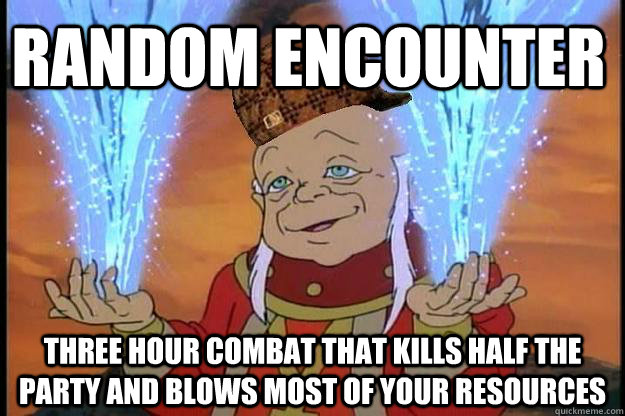
I have been told that wandering monsters in D&D are there to keep the PCs from resting/healing after every encounter and slowing the in-game pace down by doing so. It is difficult to return to full HP if there are owlbears around every corner, waiting to eat you. Of course, there is not always a lot of explanation for the presence of all those owlbears, their presence is all game mechanics, as illustrated here:
Not Cool, DM. Not Cool.
Despite the descriptive ‘random’, encounters in Traveller should serve more purpose than that. An encounter that seems random to the players can be a powerful tool for the referee to craft short adventures, put color into the setting, and create pathways to new adventures.
 

Since Traveller likes to do things by sixes, here are six things the Referee should know about every Random Encounter

Wednesday, May 21, 2014

Duct Tape makes you smart


"Guns make you stupid; duct tape makes you smart." 
       Michael Westen, the main character in the USA network show Burn Notice, said this once or twice during the run of the show. I always liked that attitude, it was part of what kept me watching the show. Michael claimed to prefer gadgets and trickery to direct violence (although he would employ it when there was no other choice); he declared that killing people usually caused more problems than it solved. 

     I saw no indications of Christian idealism on Michael's part; it was a pragmatic choice for him, and for the writers of the show. Michael's resourcefulness was a key ingredient in the style of the show. For me, that was what made the show fun to watch.

    In RPG's (Traveller as much as any) there is a lot of emphasis placed on the combat rules, and much space in the rule books is dedicated to cataloging weapons. This makes sense, combat is a source of tension & drama, and those elements are part of what makes an RPG interesting. But do the combat rules discourage or negate imaginative solutions to the challenges of the game?  Do guns, as Michael attests, make you stupid? What about sneaky or non-lethal means of subduing opponents who won't listen to reason?

     Or worse, does roleplaying allow people to indulge in sociopathic behavior by making "just shoot them" an acceptable method of problem solving?


       PCs who are of Lawful Good or Principled alignments (whether Christians or some other religion) should look for non-lethal (and hopefully non-violent) ways to deal with opposition. In my TU, even non-Christian PCs who take jobs where the Church is the patron will be required to refrain from deadly force or face nullification of the contract; the Church will not sanction deadly force being used on its behalf. Devout Christian characters, monks for example, will prefer to suffer violence to their own persons than to be directly or indirectly responsible for the death of another person. The relationship of the Church to the State's use of force is outside the scope of this discussion; I'm talking specifically about person to person interactions. 

To illustrate my point:

    This morning over breakfast, my boys and I were discussing their options in our current Traveller game. Joe and Jay, their characters, are currently scoping out an airbase way back in the hinterland of their world, obviously meant to be a secret facility, and not one sponsored by the government. They were there because the head of the local intelligence agency recruited them, as he was concerned about moles who could alert the opposition to his movements.

    One of the pair suggested that their group (2 PCs and 2 NPCs) should open fire from cover and 'take out' all the guards at one time so that they could get into the airbase. The other opposed the idea, pointing out that if they failed to get all the guards in the first round, the flash & bang would give away their position. The first responded, correctly, that lasers (two of the group had lasers) make neither smoke nor sound. 

     At this point, I interrupted to get them to see the larger picture.  Hooray for the Socratic method!

Q: What was your mission?  
A: To find out what's going on here. 
Q: Are Joe & Jay authorized law enforcement agents? 
A: No.
Q: Are the guards at the base actively committing a violent crime at this moment? 
A: No. 
Q: What do you call an unprovoked deadly attack by a civilian upon another person?  
A: Oh. Murder. (sheepish looks)
Yup.
Q: What might be a better way to handle this? A: they started planning ways they could bluff their way past the guards to get inside the base. 

     Now, my kids are not sociopaths, they're kids. They had not thought the issue through very well, until I reminded them of the moral aspect of their actions. But be honest all you adult gamers. How many of you, if presented with this scenario, would have considered if not used the 'shoot first' strategy?  As a teenage gamer, I would have. 

     That's not very good role-playing is it?  Find yourself some duct tape or its high-tech/fantasy equivalent and outsmart your opponents. That's also a much better story to tell later than "we shot them". 

     To come back around to Michael Westen, here's a case where Traveller players can employ the much discussed and debated Jack of All Trades skill - let JOT skill represent the character's ability as a gadgeteer or Macguyver. Just about every episode Michael would cobble together some useful gadget from at-hand components "and some other stuff".  With this idea, having more than one level of JOT would actually confer increasing positive DMs. The referee would have to give more thought to the details of adventure locations, and PCs can start collecting bits of gear like real people do.

Tuesday, April 15, 2014

What Gamers need to know about Surveillance


     Most gamers at some point have found themselves involved in spying on someone, or breaking into a secured area to do something, or stopping NPC's from doing the same to the PC's interests. I certainly have, from Top Secret to Traveller to Twilight:2000. Yet upon some reflection on this subject I have realized that for the vast majority of my games, whether as a player or as a GM, my handling of reconnaissance and surveillance has been rather awful. My players and my characters have walked blindly into military bases and corporate buildings as casually as walking into the mall, without being detected or stopped. The level of ineptitude is completely unrealistic and has robbed many games of a dramatic tension that would have made for a much better story.

     So I've done some looking about in the RPG books that I have, trying to find the surveillance and reconnaissance rules I've been missing. To my surprise, it's not that I was ignoring them, there just weren't many to find.

  • GURPS book Espionage: almost no discussion of surveillance
  • Original Top Secret: has an Observation skill but no mechanics for using it
  • James Bond RPG: no rules for surveillance
  • Traveller: BK4/Mercenary has recon rules, but its use is limited to mostly a DM on surprise rolls prior to combat.
  • D&D: none that I could find.

I recently purchased a copy of the original Spycraft rules (a D20 system) from DriveThruRPG. Finally, a rules set that addresses surveillance, both in interpreting photo/video data, and eyes-on intelligence gathering. It would not be difficult to incorporate the following information into the rules for the surveillance skill in Spycraft.

      It may not be a surprise to my faithful readers that I got onto thinking about this subject as a result of some articles from STRATFOR that I've read. Http://www.stratfor.com/weekly/detecting-terrorist-surveillance is one such article, if you want to read more, search their site on the terms “protective intelligence” “attack cycle” and “situational awareness” - all of these are concepts that anyone can put into practice in their own life for their own safety.


Here's another article from The Art of Manliness on Developing Situational Awareness, including a clip from The Bourne Identity. Jason Bourne could fit easily into a Traveller game as an NPC.

Without getting into game mechanics, here are some thoughts on how to incorporate information-gathering activities into a game. The Stratfor article puts it this way: "Surveillance can be defined as 'watching someone while attempting not to be caught doing so'".Countersurveillance (CS) is the reverse, attempting to catch others watching you or your things.

What is Surveillance and How do you do it?

Surveillance has two components, which I'll call the what and the how. The 'What' part is determining the appropriate target to be watched - you have to know where your opponents are before you can watch what they're doing. Beyond simply saying "that building over there" the agents need to know the target's significance, its strengths and weaknesses in resisting penetration, and what specific security measures are being employed. Another part of the 'what' is finding a good location from which to observe the target. This is known as a 'perch' in intelligence lingo. A good perch allows clear visual access to the target while being difficult to spot from the target. A car parked on an entrance road where there are no other cars present is not a good perch, but a car in the middle of a full parking lot can be one.

The 'how' part is getting your agent's eyes or detection gear on the target without being noticed. Two related concepts that are critical to the 'how' of setting up good surveillance are described by Stratfor and others as cover for action and cover for status. Cover for status addresses the question of the agent belonging in the environment. In other words, does the agent appear to observers to have a reason for being where he is? Is the agent dressed in a way that stands out or in a way that blends in? Think of plain-clothes detective work. Similarly, cover for action is the plausibility of the agent doing what he is doing. Someone sitting in a parked car, holding binoculars while looking at your building is going to draw attention unless there is some other good reason in that environment for the person to be doing that. An agent dressed as a delivery guy moving packages in and out of a delivery truck has both cover for status and cover for action. 
    
 If either of these are not thought out or done well, then the agent will stick out as being 'out of place' and the enemy will attempt to 'blow their cover' by challenging the agent's right to be there. Of course this could be a ploy to draw attention away from the spy who does have good cover. It should be hard for the agents to tell, at least initially, if their cover is blown. Keep in mind that surveillance & CS tasks are uncertain; the PCs should not automatically know whether their efforts are successful or when/if they have been spotted.

  A psychological phenomenon that comes into play while conducting surveillance is called “Burn Syndrome”. It is a reflex to 'break cover' as a result of the perception of being spotted. The GM can require some kind of determination task from the agent if he thinks he has been spotted. Failing this means that the agent did something that breaks his cover for status or action, and the enemy is alerted, whether or not the agent had been spotted previously.

Good surveillance takes time, so don't let the PC's sit for just ten minutes and then tell them everything they want to know. It could take hours or even days to properly evaluate a target - learning guard schedules or employee break times, identifying the guards who are slack or those who are super-vigilant, spotting all of the mechanical security devices.

Have lots of uncertain task rolls for Observation/Vision/Surveillance or however the skill is described in your game system. Never let them think they know everything, and make your own rolls for the NPCs conducting security & CS for the location. If you put some thought to a location's security measures and give a compelling reason why it is vital for the PC's to get into the location, a stakeout by itself can be a tense, interesting game session that may even challenge the player's nerves, let alone their PC's.

Image courtesy of Flickr http://www.flickr.com/photos/igoussev/3457787302/