Showing posts with label Science. Show all posts

Friday, January 15, 2021

How much room is there on a planet?

Talavera, the capital of the Empire of my Church and Empire setting, is a large planet with vast oceans. The UPP is A-969835-F, and 947 million people. But how much room do they actually have for a billion people?

Size 9: 9,000 mile diameter

Hydro 9: 90% of the planet is oceans

I had an initial idea of a densely populated island, where the buildings reach high into the sky to make room for nearly a billion people.

Then I did some math. What I found was, to say the least, not that dramatic.

Talavera has 25,446,900 square miles of land area. Spread 947,000,000 people over that and you get a population density of 37.215 ppl/mi^2.

According to this table of population densities of countries, that's less than Norway or Sweden. Neither are the sorts of places you think of when you think of dense populations. China, at 378 ppl/mi^2 is ten times denser. 25 million square miles is several times the size of Russia.

I did up a table to compute the square miles of surface area on planets in Traveller. By taking the Size code and cross-referencing with the Hydrographics code, you can find the land area of any planet of normal parameters. It may be water, it may be ice, it can be some other kind of liquid.

Here is a sample of the table, including a few Earth examples for comparison. The entire table, in MS Excel format, is available here.  The long and short of it is this: any planet is going to have plenty of room for exploration, or to hide something or someone. Even a Size-2 planet with Hydro-5 has space near to the size of Russia to work with.

Of this area, only a scant percentage is going to be inhabited, unless A) the population is in the Billions or above and B) most of the planet is covered by liquid or ice. A planet with only a few million people is going to be 90+% uninhabited.

What might go on in the frontier areas of a lightly populated world? Possibly a lot.  Share your ideas in the comments.
 
Size Code Diameter Radius Total Area Hydrographic-5
0 500.0 250.0 785,398.2 392,699.1
1 1,000.0 500.0 3,141,592.7 1,570,796.4
2 2,000.0 1,000.0 12,566,370.8 6,283,185.4
3 3,000.0 1,500.0 28,274,334.3 14,137,167.2
4 4,000.0 2,000.0 50,265,483.2 25,132,741.6
5 5,000.0 2,500.0 78,539,817.5 39,269,908.8
6 6,000.0 3,000.0 113,097,337.2 56,548,668.6
7 7,000.0 3,500.0 153,938,042.3 76,969,021.2
8 8,000.0 4,000.0 201,061,932.8 100,530,966.4
9 9,000.0 4,500.0 254,469,008.7 127,234,504.4
10 (A) 10,000.0 5,000.0 314,159,270.0 157,079,635.0


Russia

6,601,670
China

3,600,950
Canada

3,511,023
USA

3,531,925
Brazil

3,266,584
Australia

2,947,336


Texas

261,231
California

155,779
New York

47,126


Friday, September 13, 2019

Asteroid Visualization - Bennu

I have followed with great interest the OSIRIS-REx Mission to Asteroid Bennu (1999 RQ36), discovered twenty years ago this month! The next step in its exploration is to attempt a landing of the O-R spacecraft on it's rocky surface. It's a microgravity environment, and a challenging operation to conduct remotely.


Best of luck to the NASA team that's running this mission. 

What could a space-faring Traveller find by landing on such a small object?  What degree of difficulty would there be for the Pilot?  Share your thoughts in the comments.


Thursday, November 30, 2017

The Scientist Career Revisited

Citizens of the Imperium introduced the Scientist prior career. My first thoughts (years ago now) when I looked at it were "Who wants to play a lab-coat wearing test tube jockey [not a direct quote]" and "why are there no Science skills for a career called Scientist?"


Time for a re-evaluation. Is it really that bad of a choice of career?
It's gonna be for him, as soon as he gets a case of that super-virus.


Not all scientists are laboratory Researchers - lots of of Scientists are practically applying what's already been discovered/learned. A quick look over the skills list for scientists tells you these are not lab-coat wearing office dwellers. Traveller scientists are probably practitioners, or possibly field researchers.

All of the UPP characteristics except social standing can be improved. The service has a blend of technical skills, interpersonal skills, social skills, and a few slots for vehicle and weapons skills. This service does have it all. There's even Navigation skill, which will come in handy as one of the benefits is a laboratory ship. A scientist with Navigation can claim to be familiar with shipboard life, and be able to manage the ship. In the advanced education table there's an entry for Leadership skill, which will also be useful for directing a crew of NPCs.
Navigation suggests a focus on Astronomy. Electronics or Mechanical skill can mean degrees in those Engineering specialties. Gravitics and Computer are also engineering specialties. You could argue that the Scientist career is really the Engineers career.

But it is only for the exceptional and clever! The enlistment throw is comparable with sailors flyers and rogues, but the DMs are hard to get: INT 9+ and EDU 10+ and this is the only service that depends entirely on brain power. Survival is harder (5+) than bureaucrats, nobles, doctors and diplomats; and as hard as for sailors and flyers. Clearly these scientists do more than hang about in laboratories.

For comparison, I searched around for examples of scientist or scientifically-minded heroes in literature and television. Here's a sampling of what I found:

Wednesday, September 13, 2017

Laser weapons are coming

Beam Lasers are designated at TL-9 technology in Classic Traveller, as heavy weapons. TL 9 is noted on the Technological Levels chart as being approximately 1990-2000. Okay, so they were off the mark with that one. We were supposed to have fusion and contra-gravity by now. (Don't I wish) However, the tech of the Far Future is getting closer. Take a look:

What else could they call it except Dragonfire?


Behold the UK Dragonfire laser weapon system, currently on display at the 2017 DSEI exposition (Defense and Security Equipment International). According to the Janes' 360 website:
"The system aims to offer highly accurate targeting, allowing it to hit specific parts of an aircraft, for example. Such accuracy gives greater flexibility in target engagement, potentially allowing an LDEW [laser directed energy weapon] system to disrupt or dazzle the target, as well as to destroy it."
The Dragonfire is mounted aboard naval vessels and serves as an anti-aircraft and anti-missile platform. Sounds like the fore-runner of starship turret weaponry to me.

If your PCs are operating as mercenaries or involved in Striker battles on TL 8-10 worlds, the Janes' site offers information on real-world tech that can be upgraded and imported into your Traveller games. Check it out and find some inspiration

Monday, August 3, 2015

Is space still dangerous in the Far Future?

Last night for our weekly movie night we watched 1986's Space Camp. Overall it was a good movie; perhaps not the most dramatic but a fun sit. In short, a group of teenagers attending NASA's Space Camp get accidentally launched into orbit in a shuttle that's only half prepared for space, and they have to get back down before the run out of oxygen and die.

The circumstances that led to them being in space were not that credible to me, and the practical effects  were good but not always consistent. Despite this, the main storyline was these kids and their adult supervisor suddenly having to do for real what they had been mock-training for, and coming together as a team without which they would have all died. One thing that the film did do well was demonstrate the difficulties of surviving in space and in zero-G. There was the lack of air, the disorientation of zero-G and the problem of not being able to stop or turn easily. Everything takes longer in space, and the hostile environment will kill you if you let your guard down. The kids all showed the fear that weighed on them as they tried to survive and get home.

Flash forward by several hundred years to the present in my TU, which is the year 924 SA (Space Age). The new calendar began sometime in the 22nd century AD when Jump Drive was introduced. Mankind has reached out into space. I wonder if they still think it's dangerous?


Friday, July 17, 2015

Hold the Line, Please! Distance and Communication in space

Pluto has been hot news recently especially among sci-fi fans and gamers. As it is one of the most distant objects in our solar system, the New Horizons spacecraft took nine long years to reach it. That's a long way away, and brings me to the point of this post, which is this:
SPACE IS VAST. SERIOUSLY. IT IS BIGGER THAN YOU CAN IMAGINE.

Wednesday, July 15, 2015

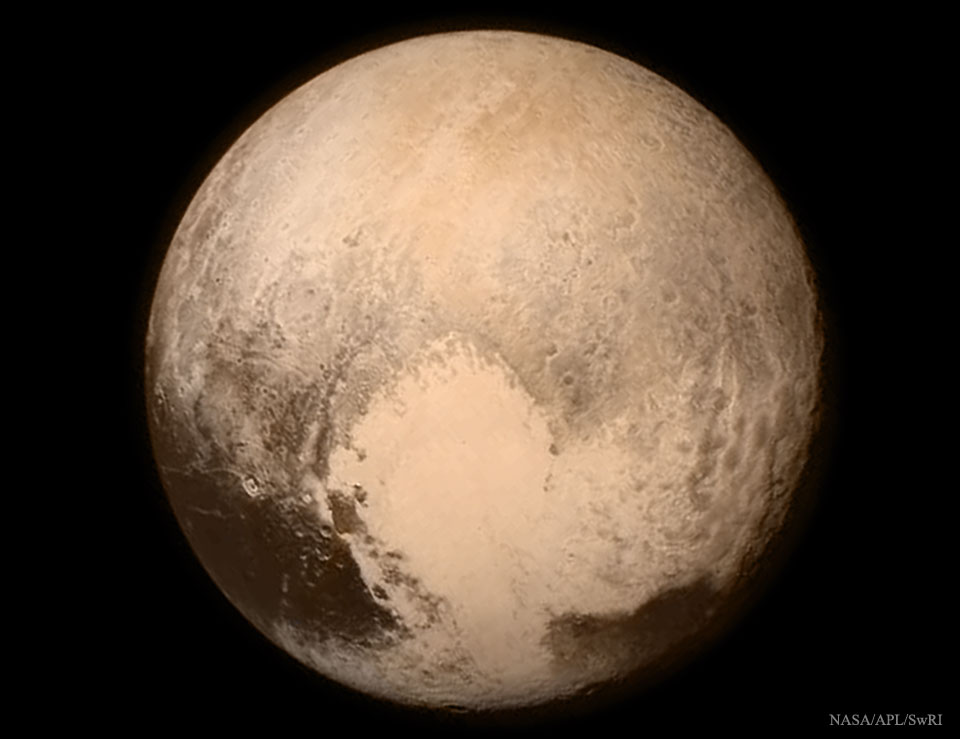
New Horizons spacecraft first photo of Pluto

From NASA's Astronomy Picture of the Day for July 15, 2015:

New Horizons has survived its close encounter with Pluto and has resumed sending back images and data. The robotic spacecraft reported back on time, with all systems working, and with the expected volume of data stored. Featured here is the highest resolution image of Pluto taken before closest approach, an image that really brings Pluto into a satisfying focus. At first glance, Pluto is reddish and has several craters. Toward the image bottom is a surprisingly featureless light-covered region that resembles an iconic heart, and mountainous terrain appears on the lower right. This image, however, is only the beginning. As more images and data pour in today, during the coming week, and over the next year, humanity's understanding of Pluto and its moons will likely become revolutionized.
The Heavens declare the Glory of God


Pluto     X-110000-0


Wednesday, April 8, 2015

Infographic of the Day: Ocean Worlds

NASA says that our solar system has many bodies that have surface or sub-surface water. Some water is liquid but much of it is ice. Jupiter's moon Ganymede may even have a salt-water ocean beneath its surface! 

Infographic: Ocean Worlds


Traveller referees, this is a new way to interpret the Hydrographic code of the Universal World Profile (UWP).  Any Hydrographic code above zero indicates the presence of water on a world, but it doesn't say that all of that water has to be on the surface!  There could be vast subterranean oceans of liquid water, even on worlds where the Atmospheric code indicates tainted or dangerous atmospheres. This could help explain why there are populated worlds with Corrosive atmospheres - the inhabitants live underground, and extract minerals from the ice or water below the surface.

Wednesday, March 11, 2015

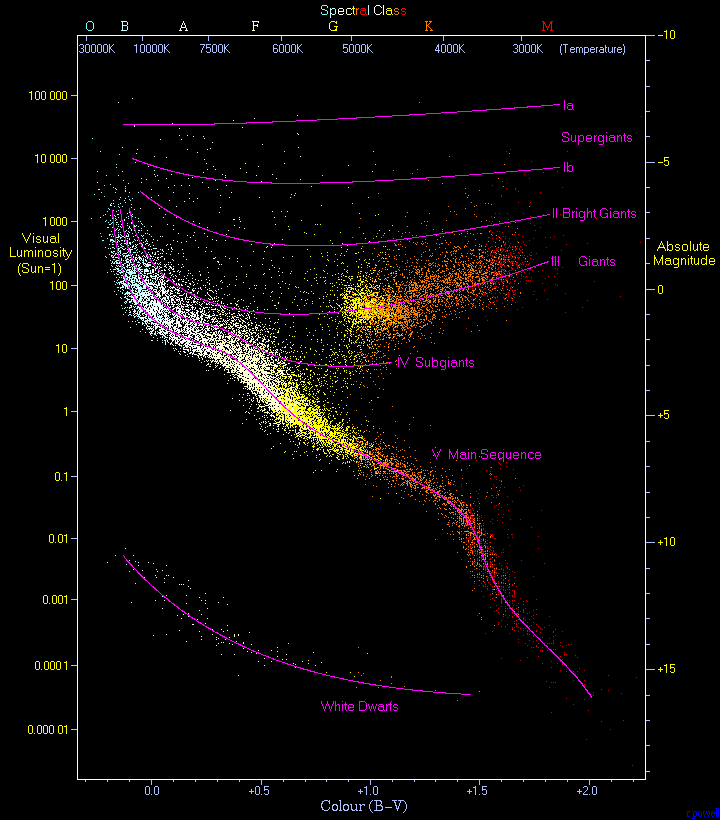
Science for your Game - Stellar Luminosity and Spectra

The Hertzsprung-Russel Diagram of Stellar Luminosity


I have used the Heaven & Earth program to detail star systems, and recently I've (re-)acquired Book 6: Scouts, so I can use the extended system generation procedures. But without some kind of visual reference, the Spectra & Luminosity attributes of stars was always vague to me. This diagram provides some much-needed context to understand the variation among stars.

For me the most important thing is the average temperature each spectral type. As I have been learning a little bit about exoplanets, I'm discovering how difficult it is to find planets in a star's habitable zone such that some kind of life might exist there. Traveller takes liberties with astronomy in this regard in order to have planets where humans can breathe the air, and where alien animals are a common occurrence. The extended system generation process gives out a lot of planets that are way too hot or too cold for life-as-we-know-it to exist, and it is a serious challenge for humans to create habitats on those planets. 

Even the basic world generation system creates lots of planets with challenging surface conditions, which I consider to be one of the system's strengths - and this system was designed in the 1970's before the search for exoplanets had really gotten going, so the designers were just speculating. Seems they weren't too far off.

So referees, instead of the next world your PCs visit being another subtropical paradise, send them to a world with a mean surface temperature of 400 K, orbiting a white supergiant which is blasting out cosmic radiation at hull-melting intensities. That'll get their attention!

Tuesday, February 24, 2015

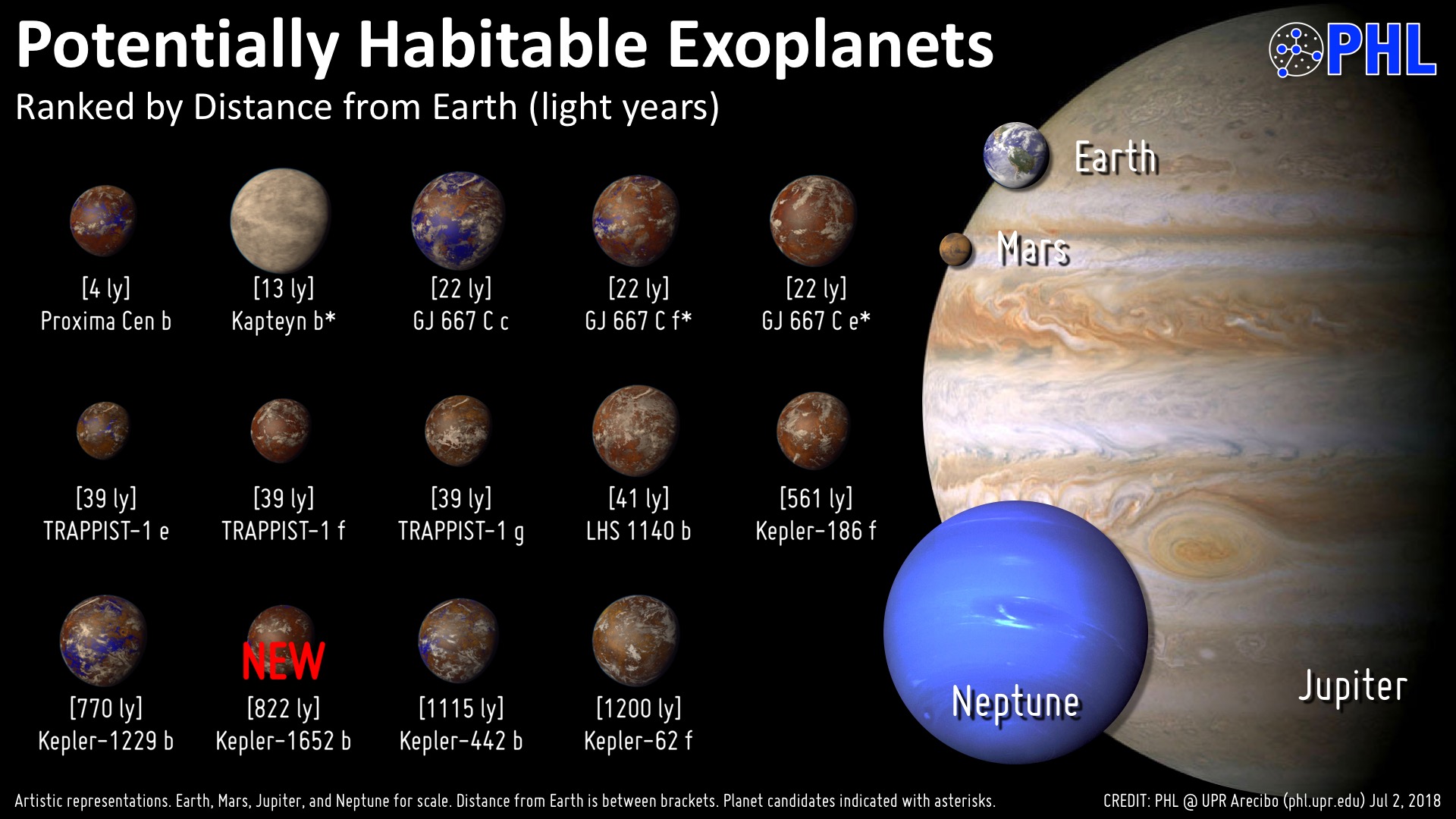
Science for your Game - The Habitable Exoplanets Catalog


The University of Puerto Rico at Arecibo hosts the  Habitable Planets Catalog, a graphical resource on the nearly 1000 exoplanets so far discovered. They include a Primer on Habitable Planets. Traveller players or referees who want exploration missions on 'strange new worlds' will find useful and interesting information.
 
The Catalog offers basic astronomical data, such as temperature zone, mass, radius and orbital period.  "Warm" planets are those planets in the Habitable Zone where the surface temperature is above the freezing point of water, at least for part of its orbital cycle. "Cold" planets, mostly beyond the habitable zone are below the freezing point of water for the entire cycle. "Hot" planets are nearer to their parent star than the habitable zone. 

From the data in the table, the referee can easily calculate the UWP size code, the surface gravity, and make an educated guess about the Atmosphere and Hydrosphere code. Fill in the Population, Government, Law and Tech levels as you wish.

We are still looking for a planet of similar size, atmosphere and temperature to Earth, like what we see on Star Trek, but the search for exoplanets is a very young branch of astronomy, and even in the last decade or less, the number of confirmed exoplanet findings has grown tremendously.

In Traveller, explorers have access to technology from vacc suits to sealed structures that could allow for colonization of worlds far less habitable than Earth. So the occasional "Earth-like" planet is good and reasonable, but so are all of the inhospitable ones that the world generation tables in Bk 3 produce.